

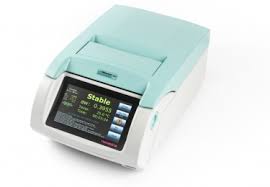
When it comes to water activity measurements, everything revolves around trust. Yet in practice, there is often skepticism about stated specifications such as accuracy and repeatability. Are these values truly achievable under real measurement conditions, or are they limited to ideal laboratory scenarios? Om precies die vraag te beantwoorden voerde Dr. Brady Carter (Carter Scientific Solutions) een onafhankelijke performance-evaluatie uit van de LabMaster Neo van Novasina. De conclusie is helder: de LabMaster Neo voldoet niet alleen aan de opgegeven specificaties, maar overtreft deze zelfs – getest onder realistische praktijkcondities.
Why this study was conducted
With over 25 years of experience in water activity measurements, Dr. Carter has observed that users frequently question stated performance specifications. This is understandable: marketing materials often reflect ideal conditions, while real-world measurements are more complex.
That is why this study was deliberately designed with:
- an independent test setup
- repeated measurements reflecting real-world use
- the use of recognized reference standards
The objective: to determine what users can truly expect from a water activity meter.
Test setup: measuring as you would in daily practice
The performance of the LabMaster Neo was tested using Novasina SAL-T saturated salt standards, known for their stable and precisely defined water activity values.
The following five standards were used to cover the full aw range:
- SAL-T 11 (0.113 aw)
- SAL-T 58 (0.5757 aw)
- SAL-T 75 (0.753 aw)
- SAL-T 84 (0.843 aw)
- SAL-T 97 (0.973 aw)
All measurements were performed at 25 °C.
Each standard was measured 10 consecutive times, with the measurement chamber opened between each measurement to force full re-equilibration. This simulates actual laboratory use.
In addition, two different NEO sensors were used to evaluate sensor-to-sensor consistency.
The LabMaster Neo was operated in slow mode, the most stringent stability setting. A measurement is only completed when the variation is no more than 0.001 aw over 6 minutes.
What do accuracy and repeatability mean?
In this study, the terms are defined as follows:
Accuracy
The degree to which the measured value matches the known reference value of the standard.
Repeatability
The consistency of successive measurements under identical conditions, expressed as the standard deviation of 10 measurements.
Both parameters are critical for quality control, validation, and reproducible product decisions.
Results: specifications confirmed and exceeded
The measurement results show that the LabMaster Neo:
- performs within or better than ±0.003 aw accuracy across the full aw range
- achieves repeatability of up to ±0.001 aw or better
- delivers consistent results across different sensors
In other words: the stated specifications are not theoretical values, but practically achievable and reproducible.
For applications in food, pharma, and R&D, this translates into maximum confidence in quality processes and audits.
What this means for you as a user
At Pedak Meettechniek, water activity is not just about measurement — it is about trust.
A quality manager must be able to rely fully on measurement results, day after day.
This independent report demonstrates exactly that:
- no marketing claims
- no idealized lab scenarios
- but objectively validated performance under real-world conditions